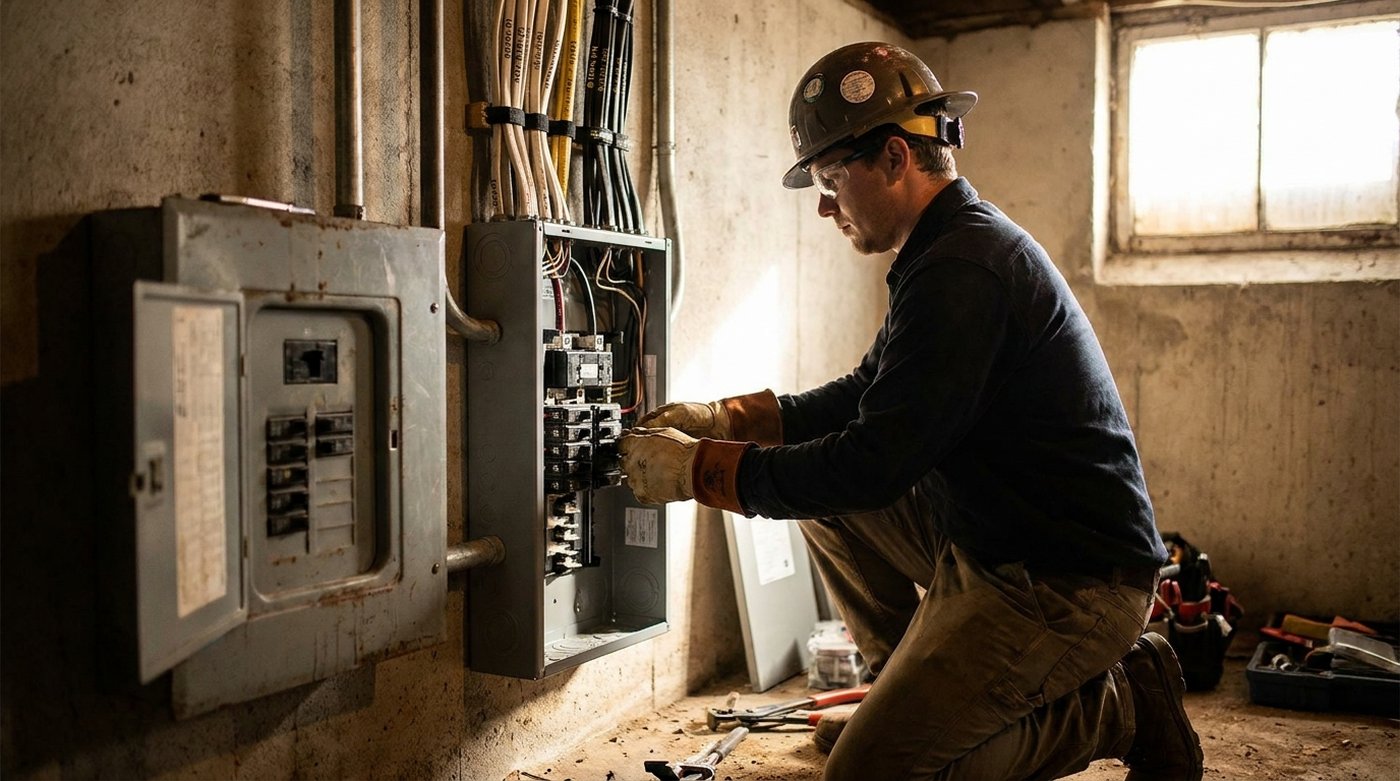
Plenty of houses built before the 1990s were wired for 100-amp electrical service. That was enough when a household ran a few lights, a refrigerator, and a television. Today the same house may also run central air, an electric range, a home office, and maybe an EV charger. This guide covers what upgrading from 100-amp service involves, what drives the cost, and how to approach the project safely.
The advice here comes from the same practical angle that shapes Allen Spearman’s work in mechanical trades: size the system for the load it actually has to carry. In the Philadelphia rowhomes Allen Spearman has rehabbed, the original panel is often the first thing that has to go.
What 100-Amp Service Actually Means
Your electrical service is the amount of power that can flow from the utility into your home at one time. On a standard 240-volt residential system, 100 amps works out to roughly 24,000 watts at the absolute limit. Nobody should plan to run a panel at its limit all day. Electricians size a service with a load calculation that accounts for the size of the house and the major appliances in it.
A 100-amp panel is not automatically unsafe. A smaller home with gas heat and gas cooking can run on it for years. Problems start when demand keeps growing on a system that was never designed for it.
Warning Signs Your Panel Is Maxed Out
A struggling panel usually gives you hints. Watch for these:
- Breakers that trip often, especially when you run a microwave, hair dryer, or space heater at the same time.
- Lights that dim or flicker when large appliances start up.
- A panel with no open slots, or one full of double-tapped breakers added to squeeze in more circuits.
- Extension cords and power strips running everywhere because there are not enough circuits.
- A warm panel cover, a burning smell, buzzing sounds, or scorch marks. Treat these as an emergency and call a licensed electrician right away.
- A panel brand or model that your electrician flags as a known safety concern.
If you see more than one of these, ask an electrician to inspect the panel and calculate your actual load before you add anything else to the system.
Projects That Push You Toward 200 Amps
Some projects add enough demand that a service upgrade becomes the sensible first step:
- EV charging. A Level 2 charger is a large continuous load and often needs its own dedicated circuit.
- Heat pumps, central air, and electric heat. Moving from gas or oil to electric heating adds a big load. This is where mechanical and electrical planning have to happen together, a lesson that comes from years spent working inside older mechanical systems.
- Kitchen remodels. Electric ranges, wall ovens, dishwashers, and disposals each need their own circuits.
- Additions and finished basements. More square footage means more lighting, outlets, and usually more HVAC capacity.
- Home offices, workshops, and hot tubs. Each adds equipment that runs for hours at a time.
- Solar and battery storage. The service and panel have to accommodate the equipment safely.
Doing the upgrade before these projects start keeps you from opening the same walls twice.
Inside a 200-Amp Service Upgrade
Moving to 200 amps is the standard step up for a modern single-family home. A complete upgrade typically includes:
- A load calculation. The electrician confirms the size of service your home needs.
- A permit. Service work almost always requires a permit and an inspection from your local authority.
- A new main panel. It is rated for 200 amps and has room for more circuits.
- New service entrance conductors. The heavier wires from the utility connection to your panel are replaced with larger ones.
- A new meter socket, if the existing one is not rated for the higher load.
- Updated grounding and bonding. The system has to meet current code.
- Utility coordination. The utility usually has to disconnect and reconnect power, and sometimes upgrade its own equipment.
- An inspection. The work is approved before power is restored for normal use.
Expect the power to be off for several hours during the changeover. A straightforward swap often fits in one day, while a new service mast, a relocated meter, or utility work can stretch it out.
What Drives the Price of a Service Upgrade
Costs vary a lot by region, house, and the condition of your current equipment. Quotes commonly land in the range of a few thousand dollars, and complex jobs can run higher. Several factors move the number:
- The distance between the meter, the panel, and the utility connection.
- Whether the service comes in overhead or underground.
- Whether the meter socket, mast, or service cable must be replaced.
- The condition of existing wiring and grounding, and any code fixes the inspector requires.
- Local permit fees and utility charges.
- Extras such as added circuits, surge protection, or a panel with space for future additions.
Get at least two written quotes that spell out what is included. A low number that leaves out the permit, the utility coordination, or the meter socket is not really a lower price.
Permits, Inspections, and Why This Is Not a DIY Job
A service upgrade touches the highest-energy part of your electrical system. The conductors ahead of the main breaker are energized by the utility, and a mistake there can cause serious injury, fire, or equipment damage. In most places the work must be done by a licensed electrician, and unpermitted work can cause trouble with insurance claims and when you sell.
Requirements differ by location, so confirm them with your electrician and your building department. A reputable contractor pulls the permit, schedules the inspection, and handles communication with the utility.
Hiring a Licensed Electrician You Can Trust
Who does the work matters more than the brand of the panel. Before you sign, check that the electrician:
- Holds a valid license in your state or city and carries liability insurance and workers’ compensation.
- Provides a written, itemized estimate and explains the load calculation.
- Pulls permits under their own license and schedules the inspection.
- Has done service upgrades in homes similar to yours, especially if yours is an older rowhome or has a tight basement.
- Offers references and a warranty on the work.
Is the Upgrade Worth It?
For a lot of households, yes. A 200-amp service leaves room for an EV charger, a heat pump, or a remodeled kitchen without overloading the system. It also cuts down on nuisance tripping, makes adding circuits easier, and gives buyers the capacity they expect in a modern home. If your needs are modest and your panel is in good shape, an inspection may show you can wait.
Your Next Steps
- List the major appliances you run now and the projects you expect in the next five years.
- Check your panel label for its rating, and note open slots or warning signs.
- Ask a licensed electrician for a load calculation and a written estimate.
- Confirm permit and inspection requirements with your local building department.
- If you want to talk through a panel or mechanical upgrade, reach out before the work is scheduled.
This article is general information, not a substitute for advice from a licensed electrician or your local building department. Electrical codes and requirements vary by location.
About the Author
Allen Spearman is a Philadelphia business owner with a background in the mechanical trades, including HVAC, and years of experience rehabbing homes across the region. Read more about Allen’s background, or connect with him on LinkedIn.